
This is a simple, reliable 100% whole wheat bread recipe made with fresh milled flour. It’s the one I make most often – usually two or three times a week – and it’s a great starting point if you’re new to baking fresh ground wheat bread at home.
This recipe works well as a whole wheat sandwich bread – it’s soft enough to slice easily and sturdy enough for everyday use.
If you’re looking for a fresh milled wheat bread recipe that works consistently, this is the place to start.
Why This Recipe Works
- simple method that works for beginners
- uses fresh milled flour for better flavor and nutrition (see → Fresh Milled Flour Benefits)
- works well with hard white or a blend of wheat types (see → Hard vs Soft Wheat)
- higher hydration for soft whole wheat bread, which is key when baking with fresh milled flour (see → Hydration Explained)
What to Expect
This is a soft, slightly hearty homemade whole wheat bread with a mild flavor. The dough will be a bit stickier than typical white bread, and that’s normal when working with fresh milled flour.
If this is your first time making fresh milled bread, stick with this recipe and make it a few times. Once you know what the dough should look like, it becomes much easier.
Print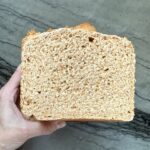
100% Whole Wheat Bread (Fresh Milled Flour)
- Total Time: 1 hour 10 minutes
- Yield: 3 loaves 1x
Description
A simple, reliable 100% whole wheat bread made with fresh milled flour. Soft, slightly hearty, and beginner-friendly.
Ingredients
- 800 g of water at 130°
- 125 g of honey
- 175 g of olive oil
- 2 eggs
- 20 g of salt
- 6 cups hard wheat berries (I use 1 ½ cups of hard red and 4 1/2 cups of hard white)
- 2 tablespoons instant yeast
Instructions
- In the bowl of a stand mixer fitted with a hook attachment, add water, honey, olive oil, eggs and salt.
- Over the top of those ingredients, grind the wheat berries with a grain mill.
- Add the yeast on top of the ground flour.
- Mix the ingredients together with the hook attachment starting slow until incorporated.
- Increase the speed to medium-high and mix for roughly 5-7 minutes or until the dough to start pulling away from the sides of the bowl.
- Let the dough rise for about 30 minutes or until doubled.
- Preheat oven to 350 degrees.
- Divide evenly into 3 loaf pans using parchment if necessary.
- Wait for it to rise until roughly doubled.
- Then bake at maybe 350 for about 20 minutes.
- Measure the internal temperature of each loaf to determine if it measures 180 degrees.
- Remove from pans and place on wire rack.
Notes
Dough will be slightly sticky – this is normal for fresh milled flour
Let dough fully double for best texture
Use hard white wheat for a lighter flavor
- Prep Time: 50 minutes
- Cook Time: 20 minutes
Start here if you’ve had trouble with whole wheat bread
If your bread has been turning out dense, dry, or not rising well, you’re not alone.
Most issues come down to a few key things:
- not enough water → dough is too dry
- not enough rise → dough didn’t develop fully
- not enough structure → dough can’t trap gas
- too much rise → dough overproofed
Before you start, you can troubleshoot here:
- see → Why Is My Whole Wheat Bread Dense
- see → How To: Fix Dough That Didn’t Rise
- see → How To: Fix Dough That Is Too Dry
This recipe is designed to avoid those problems from the start.
What your dough should look like
Before the first rise, your dough should be:
- soft and slightly sticky
- not smooth like white flour dough
- shaggy at first, then more cohesive after mixing
After mixing:
- dough should begin to pull away from the sides of the bowl
- it should hold together, but still feel soft
If your dough looks different:
- dry or crumbly → see → How To: Fix Dough That Is Too Dry
- very sticky and not improving → see → How To: Fix Dough That Is Too Sticky
How to know your dough is ready
Don’t rely on time—watch your dough.
- first rise → dough should double in size
- second rise → dough should rise above the pan
If you’re unsure:
see → How To: Tell When Dough Has Risen Enough
Why this recipe works
This recipe is designed to avoid the most common whole wheat problems:
- higher hydration → prevents dry, dense bread
- enough mixing → builds structure
- full rise → allows proper development
These three things – hydration, structure, and rise – are what make the biggest difference.
If something goes wrong
If your bread doesn’t turn out how you expected:
- dense → see → Why Is My Whole Wheat Bread Dense
- didn’t rise → see → How To: Fix Dough That Didn’t Rise
Most issues come down to small adjustments.
Key Tip Before You Start
Measure your grain, not your flour.
Instead of scooping and leveling flour, measure the wheat berries and grind them directly into your mixing bowl. It’s more consistent and removes the guesswork.
Ingredient Notes
- Wheat berries: I use a mix of hard white and hard red wheat – 3/4 hard white and 1/4 hard red. This gives a softer texture with more flavor.
- Fresh milled flour: This recipe is designed specifically for freshly milled flour. I grind the grain directly into the bowl rather than measuring flour after grinding.
- Flexibility: This is a forgiving recipe. If you’re out of eggs, you can leave them out. If you slightly overmeasure oil, it will still turn out fine.
Why We Make This + How It Fits
This is our go-to bread for everyday use. We use it for sandwiches, toast and French toast.
I make it often because it’s made with fresh ground flour and simple ingredients – no extra additives. It’s one of the easiest ways to replace store-bought bread with something better for our family. And it’s fresh – there’s nothing better than fresh baked bread.
Homemaker Notes (The Practical Details)
- Storage: Store in a plastic bag or bread bag
- Shelf life: About 1 week (watch for mold)
- Softness: Stays soft when stored sealed
- Batching: I typically make this fresh rather than doubling
- Freezing: It never makes it to our freezer but comment if you try it!
How to Know When It’s Done
Look for medium browning on the top as your first sign.
Then check the internal temperature: Bread is done at 180°F
If you under bake it, you can end up with a gooey center – this is the easiest way to make sure it’s fully baked.
FAQ
Is this truly 100% whole wheat?
Yes. This recipe uses only wheat berries that are freshly milled into flour – nothing else.
Is this a good recipe for beginners?
Yes. It’s simple, forgiving, and works well even if you make mistakes. Plus no bread shaping skills needed!
Will this whole wheat bread turn out dense?
No – this recipe makes a soft loaf, especially when using hard white wheat.
If your bread turns out dense or heavy, start here → Why Is My Whole Wheat Bread Dense?
Can you use this for sandwiches?
Yes. It works very well for sandwiches – perfect for peanut butter and jelly.
Related
- Hydration Explained (Why Whole Wheat Needs More Water)
- Hard vs Soft Wheat (Choosing Wheat Types)
- Why Is My Whole Wheat Bread Dense?
What to Make Next
If you have extra of this bread, it works well for French toast.